Baseline year
Start your energy flexibility analysis with utility NEM12 or interval data.
Understand consumption, costs, tariffs & emissions — fast
- Deep Energy AI transforms raw utility data into actionable insights, interval by interval.
- Perform data transformations, calculate tariffs, maximum demand, and emissions factors with speed and precision — powered by machine-driven algorithms.
- The result? Recreate energy retailer invoices from baseline data to validate the modelling engine.
Precision at every interval
Calculate consumption, demand, tariffs, and emissions with speed and accuracy — no manual data wrangling.
Import NEM12 or CSV data in 5, 15, 30-minute, or daily intervals using our standard template — then upload seamlessly to the database.
- Automatically calculate peak power (kVA) from Wh and VARh.
- Apply rolling maximum demand windows and seasonal logic via the tariff engine.
- Quantify emissions reductions for sustainability and carbon credit schemes.
- Integrate external datasets including weather, tariffs, and spot electricity prices.
Accurate data is the foundation of credible financial modelling.
- Validate tariffs for billing and cost projections.
- Reconcile baseline year costs against actual invoices.
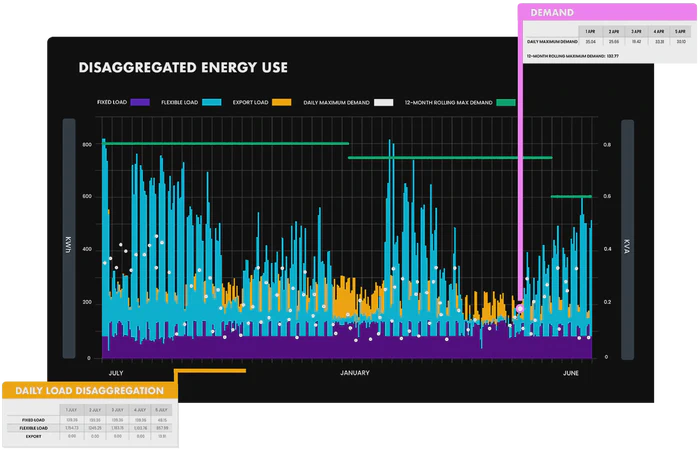
- Disaggregate flexible load from baseload using k-means clustering to identify load-shifting opportunities.
- Calculate maximum demand per rolling window and interval to assess demand reduction potential.
- Power advanced scenario modelling with interval-level precision.
Turn utility & modelling data into knowledge
Extract, transform, and validate millions of utility records in just a few clicks.
Deep Energy AI converts raw meter data — including NEM12 and CSV formats — into structured, validated time-series data ready for analysis.
- Transform utility data into a source-of-truth
Extract, transform, and validate millions of utility records in just a few clicks. Deep Energy AI converts raw meter data — including NEM12 and CSV formats — into structured, validated time-series data ready for analysis.
- Automatically calculate peak power (kVA) from Wh and VARh.
- Apply emissions factors to quantify sustainability and carbon credit impacts.
- Share results with your team, consultants, contractors and clients.
- Disaggregate load and calculate maximum demand
Identify flexible loads and evaluate demand reduction opportunities. Deep Energy AI uses machine learning and clustering algorithms to separate baseload from variable load — revealing load-shifting potential.
- Calculate rolling maximum demand across intervals and seasons.
- Visualise demand peaks and outlier events in time-series format.
- Drill into specific days to assess flexible load behavior.
- Model tariffs and build strategy scenarios
Normalize complex tariff structures and simulate financial outcomes. Deep Energy AIs tariff engine calculates charges interval by interval, standardising line items across retailers and networks.
- Validate bills and forecast energy costs under alternative tariff scenarios.
- Model ROI, technology mix, and wholesale market participation.
- Create, copy, and apply unlimited scenarios across sites — with built-in sensitivity analysis.
- Transform utility data into a source-of-truth
Extract, transform, and validate millions of utility records in just a few clicks. Deep Energy AI converts raw meter data — including NEM12 and CSV formats — into structured, validated time-series data ready for analysis.
- Automatically calculate peak power (kVA) from Wh and VARh.
- Apply emissions factors to quantify sustainability and carbon credit impacts.
- Share results with your team, consultants, contractors and clients.
- Disaggregate load and calculate maximum demand
Identify flexible loads and evaluate demand reduction opportunities. Deep Energy AI uses machine learning and clustering algorithms to separate baseload from variable load — revealing load-shifting potential.
- Calculate rolling maximum demand across intervals and seasons.
- Visualise demand peaks and outlier events in time-series format.
- Drill into specific days to assess flexible load behavior.
- Model tariffs and build strategy scenarios
Normalize complex tariff structures and simulate financial outcomes. Deep Energy AIs tariff engine calculates charges interval by interval, standardising line items across retailers and networks.
- Validate bills and forecast energy costs under alternative tariff scenarios.
- Model ROI, technology mix, and wholesale market participation.
- Create, copy, and apply unlimited scenarios across sites — with built-in sensitivity analysis.